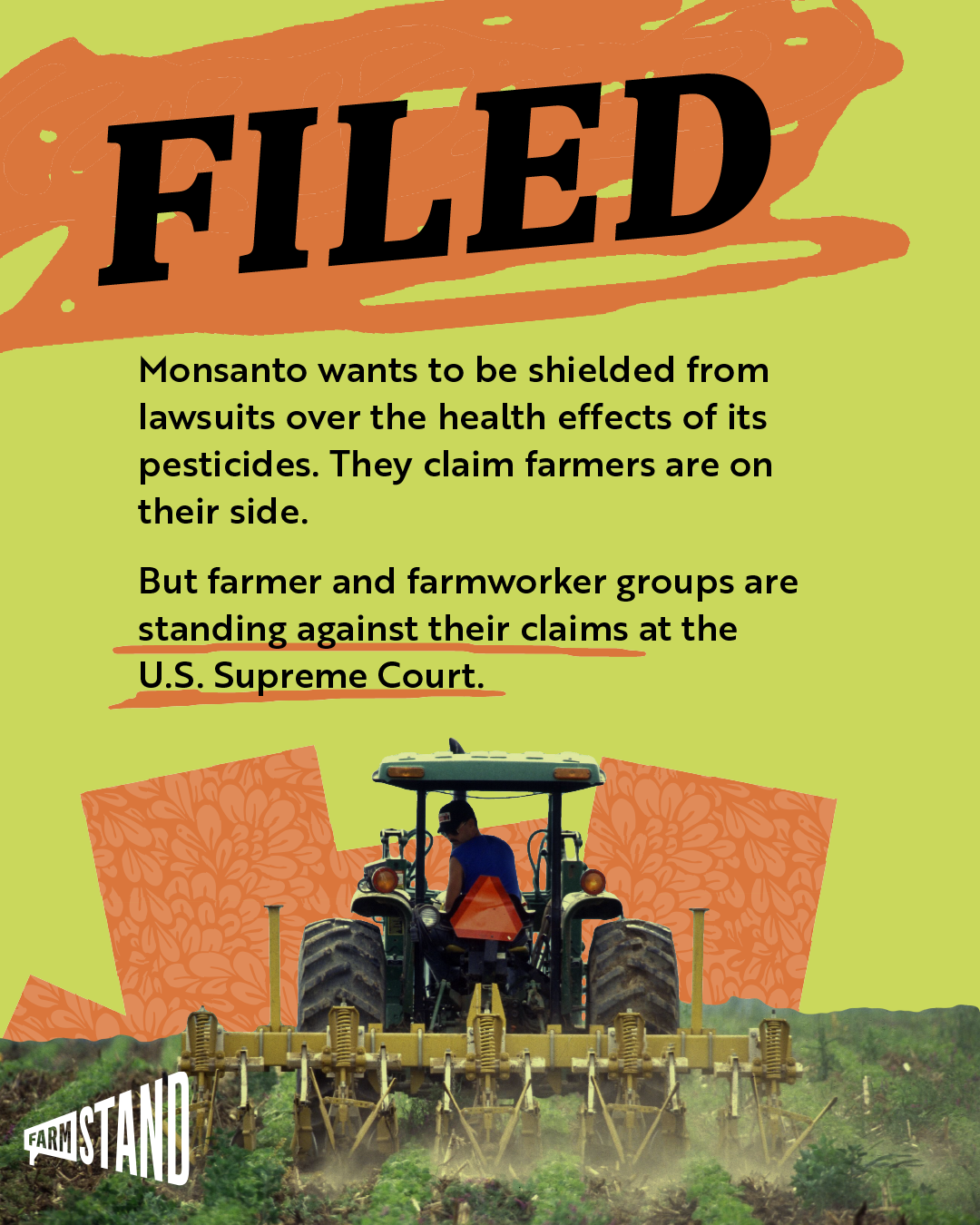
ISA joined 15 organizations in an amicus brief for the justices

Illinois Stewardship Alliance recently joined a coalition of farmer and farmworker organizations in filing an amicus brief in Monsanto Company v. Durnell to the U.S. Supreme Court.
At its core, this case centers on a failure to warn. It asks whether a corporation can be held liable under state law for failing to warn users about known health risks, like the link between glyphosate and cancer.
If the Court rules in favor of Monsanto, it could strip states of their power to protect their own citizens.
For organizations like ISA, being able to pass laws at the state level is often our best way to protect local farms when national laws fall short.
By joining this brief, ISA joins allies in arguing that protecting the company from lawsuits over its failure to warn consumers about the health effects of glyphosate in Roundup would serve corporate profits, not farmers’ health and the well-being of communities.
At first glance, this may sound like a narrow legal question. But it points to something much bigger: what accountability looks like in a deeply consolidated farm system.
When a few companies control everything from the seeds we plant to the chemicals sprayed on them, they shouldn’t also be allowed to control and hide information about whether those products are safe.
In that system, farmers are making decisions with fewer real choices. Options are limited. Products are often bundled. Prices are set by a handful of companies. And even when risks are unclear, farmers are still expected to make the best decisions they can.
When choices are limited, information matters more. Farmers need clear, honest information about the risks of the products they use – especially when those risks could affect their health, their land, or their families.
This is why the case matters.
It will help determine whether corporations can be held accountable when they fail to disclose those risks – and whether states have the authority to step in when federal action has not gone far enough.
Across Illinois, farmers are already showing what it looks like to build something different.
During Illinois Soil Health Week in March, farmers, researchers, and advocates shared practices that improve soil health, reduce input costs, and strengthen resilience – from cover crops to diversified rotations to farm with nature instead of against it.
These approaches show that farms can be productive without relying on a narrow set of tools. When corporations can hide behind liability shields and have captured markets, what drives them to innovate safer, more cost-effective solutions?
For ISA, joining this coalition – including partners like FarmSTAND and other farmer and farmworker organizations listed below – is about making sure farmers’ experiences are part of this national conversation.
Because when people better understand how consolidation shapes the choices farmers actually have, it becomes harder to ignore the need for change and the collective power needed to achieve it.
If you want to learn more about this case and ISA’s work on farm and food system accountability, stay connected by subscribing to our eNews and share this story with others who care about the future of agriculture.
Illinois Stewardship Alliance is standing in solidarity with 15 organizations from across the country for transparency and accountability in the upcoming Supreme Court Case Monsanto vs. Durnell:
- FarmSTAND
- Centro de los Derechos del Migrante (CDM)
- Dakota Resource Council (DRC)
- Dakota Rural Action (DRA)
- Farm Action
- Family Farm Defenders (FFD)
- Friends of Family Farmers
- FrontLine Farming
- HEAL Food Alliance
- The Idaho Organization of Resource Councils (IORC)
- Illinois Stewardship Alliance (ISA)
- Institute for Agriculture and Trade Policy (IATP)
- Land Stewardship Project (LSP)
- The National Family Farm Coalition (NFFC)
- National Sustainable Agriculture Coalition (NSAC)
- The Organic Farmers Association
You can stand with us by becoming a member or renewing your membership today.