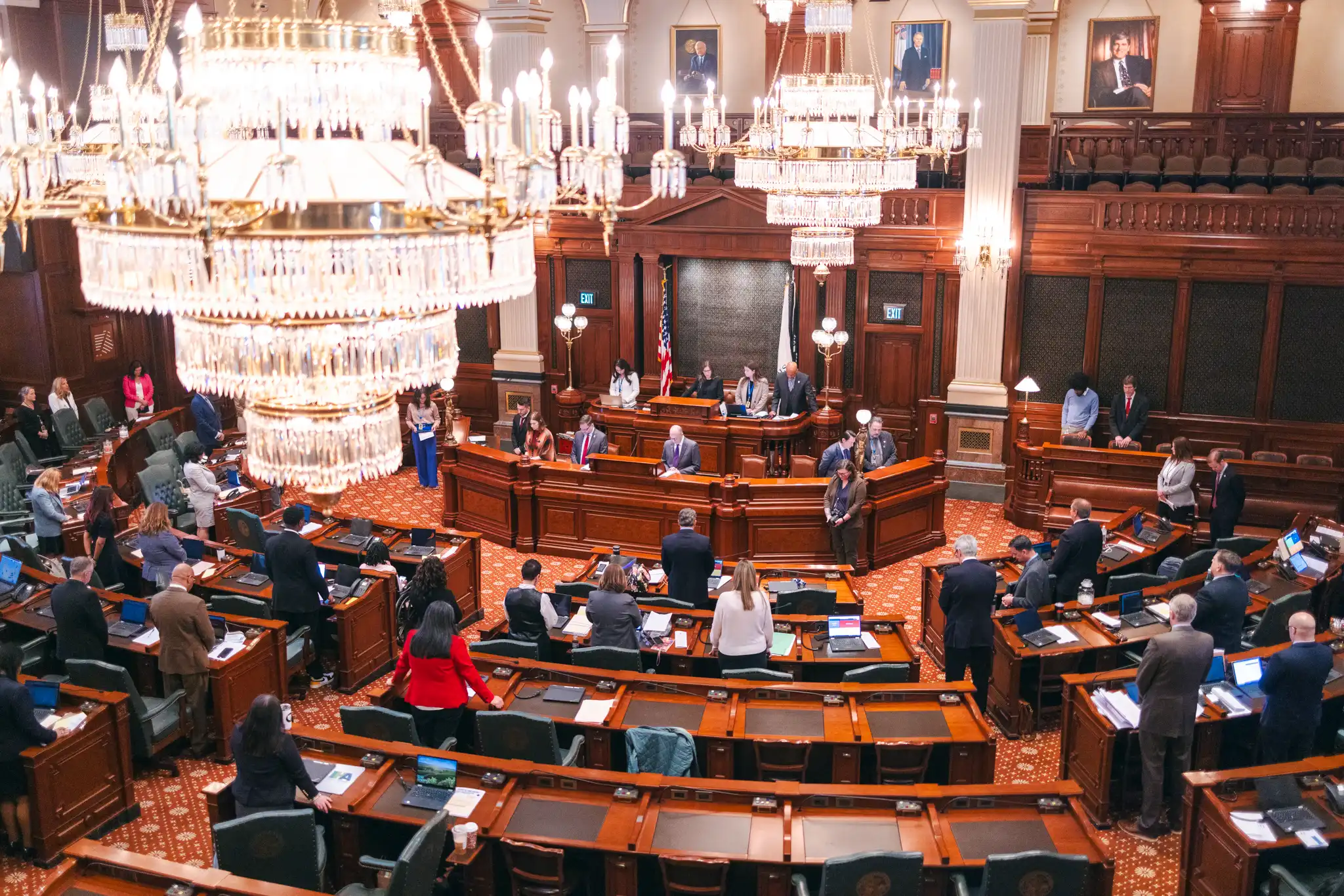
The Illinois General Assembly adjourned for the year in the wee hours of the morning on June 1st. So many of you took action–and there is plenty of progress worth celebrating,.
This session delivered important investments in local food systems, conservation programs, and hunger relief.
At the same time, lawmakers fell short on several priorities that would have strengthened support for emerging farmers, expanded land access, protected soil and water, and built a more resilient food system.
Here’s what happened.
By the Numbers
✔ Continued funding at $2 million for the Local Food Infrastructure Grant Program
✔ Increase in funding for Healthy School Meals for All from $9 to $26 million
✔ $70 million in new funding to address food insecurity caused by SNAP benefit losses
✔ $100,000 in new funding for the Farmland Transition Committee
✔ Continued level funding for the Farm-to-Foodbank program, Farmers Market Nutrition Program, Fall Covers for Spring Savings conservation program, and Ag Equity Commission
✖ Urban and Socially Disadvantaged Farmer funding cut from $2.5 million to $500,000
✖ Soil and Water Conservation Districts Budget remains underfunded at $4.5 million
✖ No action on Emerging & Socially Disadvantaged Farmer Grant program legislation
✖ No action on land access legislation
✖ No action on pesticide drift legislation to protect children in schools and daycares
✖ No action on agrivoltaics to support the co-existence of renewable energy and agriculture
✖ No action on compost reform
How We’re Building Collective Power
When we talk about power, we mean ordinary farmers, eaters, and food system leaders acting together in ways that shape decisions, influence outcomes, and change what feels possible.
Sometimes that shows up in visible wins, but it also looks like new leaders stepping forward, stronger relationships with policymakers, deeper participation in advocacy, or people gaining confidence and agency through collective action.
Not every campaign we work on together will produce a major external win– which is why recognizing and celebrating other ways in which we build power together is important.
- 700 individuals took action on our action alerts to send emails to their state and federal lawmakers on the issues they care about.
- 100’s of members filed witness slips in support of our state-level food and farm legislation
- 32 new members joined the Alliance as a result of outreach on food and farm policy
- 2 members and 1 Alliance team member testified in state legislative committee hearings for the first time ever!
- 1 member flew on the plane for the first time ever to attend a federal fly-in in D.C.
- 5 members travelled to the Springfield to talk with lawmakers during the Emerging Farmer Grant Program mini-lobby day
- More than 50 farmers and advocates travelled to Springfield to support equitable food and farm policy for Black Farmers & Growers Lobby Day
Our Top Priority: Investing in Local Food Infrastructure
WIN: Local Food Infrastructure Grant Program Preserved at $2 Million
One of our top priorities this session was protecting funding for the Local Food Infrastructure Grant Program—and we’re pleased to report lawmakers again preserved $2 million for this critical investment.
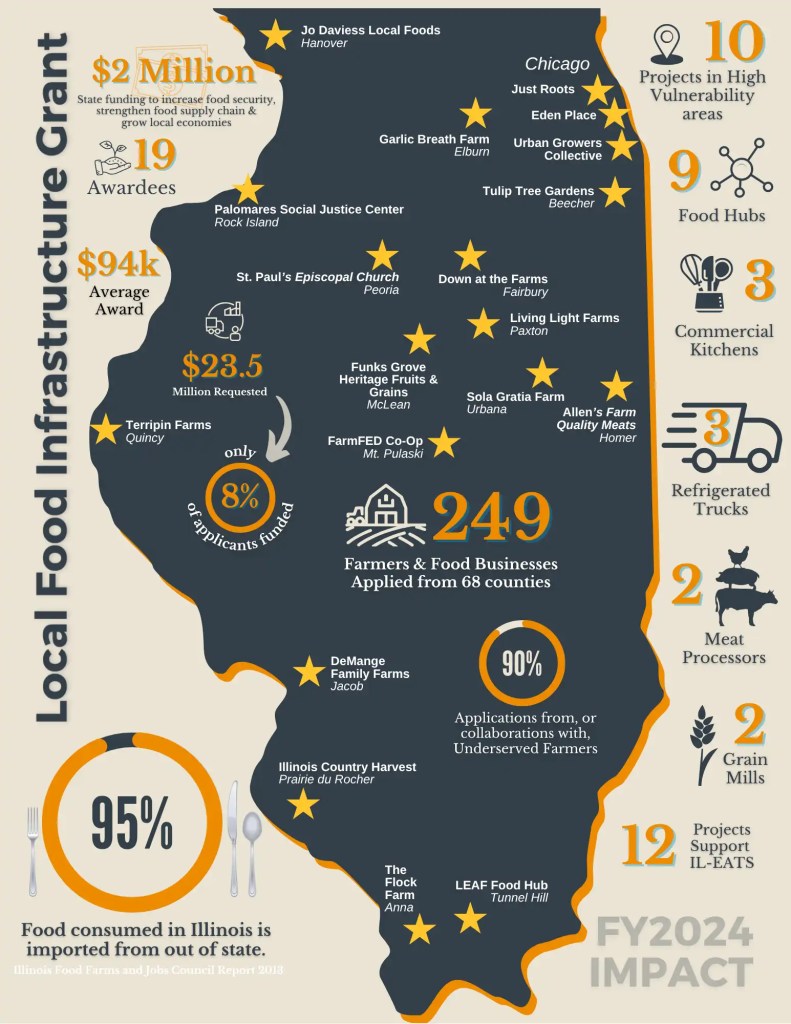
The Local Food Infrastructure Grant Program helps build the infrastructure farmers need to get food off the farm and into Illinois communities. Grants have funded food hubs, refrigerated trucks, meat processing facilities, mills, aggregation facilities, and other projects that connect Illinois farmers to schools, grocery stores, hospitals, food banks, and wholesale markets.
These projects solve one of the biggest barriers facing local food systems: a lack of food system infrastructure due to years of consolidation and monopoly control.
The impact is already visible across Illinois. These investments strengthen local supply chains, increase processing capacity, create jobs, and keep more food dollars circulating in Illinois communities.
At a time when Illinois imports approximately 95% of the food we eat despite having some of the most productive farmland in the world, investments like these are essential to building a stronger, more resilient food system.
This is one of the most effective farm and food investments Illinois makes. We are grateful for the continued bipartisan support of lawmakers and look forward to working together to grow the program in future years.
Our Top Priority: Supporting Emerging & Socially Disadvantaged Farmers
SETBACK: Funding Cut and Reform Effort Falls Short
While Illinois continues to acknowledge the challenges facing beginning, urban, and socially disadvantaged farmers, lawmakers failed to make meaningful progress toward ensuring support reaches the farmers who need it most.
The Urban and Socially Disadvantaged Farmer Program was reduced from $2.5 million to $500,000 in the final budget.
The funding cut comes after years of delays that have prevented much of the program from reaching farmers. Since 2021, approximately $2.5 million has been appropriated each year for this program is, yet only about $2 million has been distributed.
Recognizing these challenges, Illinois Stewardship Alliance members worked with Rep. Sonya Harper to advance legislation creating a programmatic framework for a new Emerging and Socially Disadvantaged Farmer Grant Program.
The proposal would have helped limited-resource farmers access the equipment, infrastructure, supplies, and operating support needed to farm in food deserts and underserved communities.
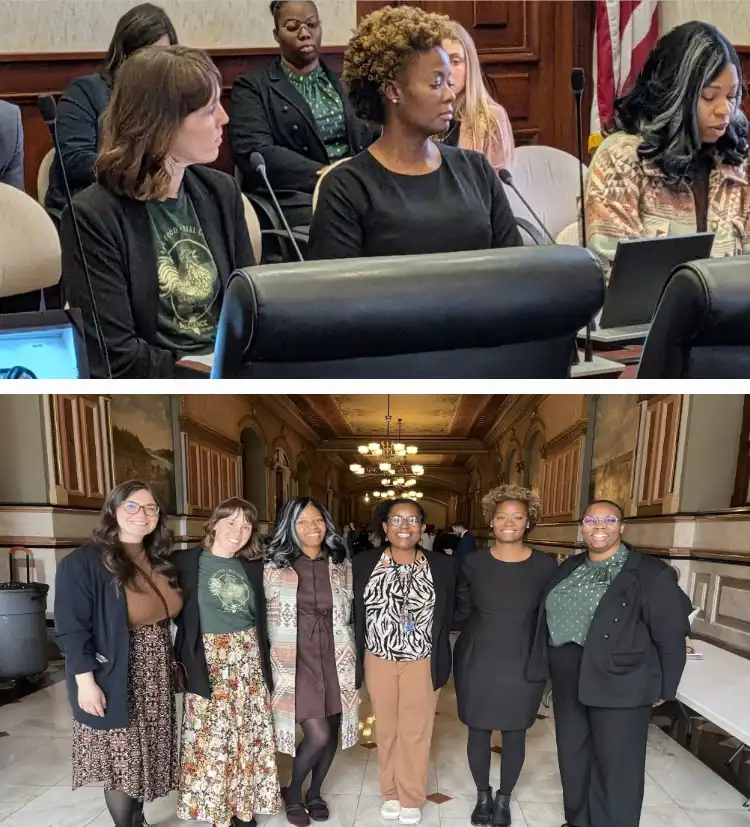
Farmers like Christal Tarver (top photo, middle) travelled to Springfield, participated in lobby days, made phone calls, and shared their stories with lawmakers in support of the proposal.
Despite those efforts, lawmakers did not advance the legislation before adjournment and ultimately reduced funding for farmer support programs.
The need remains urgent. Across Illinois, emerging and socially disadvantaged farmers face significant barriers to accessing land, equipment, infrastructure, and operating capital. These challenges are especially acute for historically underserved farmers, but they also affect many small and mid-sized farms working to build viable businesses and serve local markets.
The development of a just and regenerative farm and food system cannot happen in Illinois without supporting farmers who grow food in underserved communities and food deserts across our state.Illinois must invest in the farmers and communities that need it most. We will continue fighting for policies that address systemic barriers in the food system while ensuring communities have access to fresh, locally grown food.
Conservation & Regenerative Agriculture
WIN: Fall Covers for Spring Savings Fully Funded
Lawmakers preserved $960,000 for the Fall Covers for Spring Savings Program despite a proposed $300,000 reduction. The program rewards farmers for planting cover crops that improve soil health, reduce erosion, and protect water quality.
Our take: Programs like this one prove that incentives can help lead farmers to invest in more regenerative practices. We are grateful to see the program maintained, but demand continues to exceed available funding. Illinois should continue expanding this investment so farmers in every county have the opportunity to participate.
MISSED OPPORTUNITY: Soil & Water Conservation District Funding Remains Flat
Funding for Soil and Water Conservation Districts remains at $4.5 million.
While the level funding avoids reductions, it remains well below the estimated $10 million needed for districts to protect Illinois soil, water, climate, and fully provide conservation technical assistance to farmers.
Legislation that would have created a sustainable funding source through a land conversion fee on development projects (HB5593/SB4044) did not advance.
Our Take: Farmers are eager to adopt conservation practices, but many need technical assistance to do so. Illinois must do more to support the local conservation professionals helping farmers implement solutions.
MISSED OPPORTUNITY: No Progress on Pesticide Drift Protections
Legislation requiring advance notice before pesticide applications near schools and daycare centers failed to advance after facing significant opposition.
Our Take: As weather extremes, water quality concerns, and pesticide use continue to increase, Illinois must continue working toward solutions that protect both farmers and communities.
MISSED OPPORTUNITY: Agrivoltaics Bill Stalls
The General Assembly did not advance the Agrivoltaics Definition Act (SB2958/HB4830).
The legislation would have established a framework allowing solar energy development and agricultural production to coexist on the same land through practices such as livestock grazing, pollinator habitat, and crop production.
Our Take: Illinois has an opportunity to lead on innovative approaches that support both renewable energy and agriculture. We hope lawmakers revisit this issue in future sessions.
Good Food for All
WIN: $70 Million to Address SNAP Benefit Losses
Lawmakers approved $70 million to help address food insecurity resulting from federal SNAP cuts.
Our Take: This investment will help thousands of Illinois families access food during a period of growing economic uncertainty.
WIN: Healthy School Meals Funding Increased
Funding for Healthy School Meals increased from $9 million to $26 million.
While still far below the funding needed to provide free meals to all students, this increase represents significant progress.
Our Take: Free school meals for all reduces stigma for children and administrative burden for schools, allowing schools to move closer to their goals of serving nutritious and locally sourced food.
WIN: Farmers Market Nutrition Program Maintained
The Farmers Market Nutrition Program remains funded at $1 million.
Our Take: This program helps SNAP recipients purchase fresh food from local farmers while keeping food dollars circulating in Illinois communities.
WIN: Farm-to-Food Bank Program Maintained
Lawmakers preserved $5 million for the Farm-to-Food Bank Program.
Our Take: This program is a win-win investment that supports Illinois farmers while providing nutritious food to families facing food insecurity.
MISSED OPPORTUNITY: Hunger Coordination Bills Fail to Advance
Several bills aimed at improving coordination around food insecurity failed to advance, including the Snap Response Working Group: SB3276 (Sims) / HB5062 (Lilly) , Access to Nutrition Program: SB2923 (Fowler), Food Desert Opportunity Zones: HB5300 (Harper)
Our Take: Illinois continues to lack a coordinated statewide strategy for addressing hunger. We will continue advocating for policies that better connect agencies, organizations, and communities working to ensure everyone has access to good food.
Thriving Farmers
WIN: Continued Support for Farmer-Focused Commissions
The budget includes $100,000 for the Farmland Transition Committee and $100,000 for the Ag Equity Commission.
These groups are studying barriers to land access, farm transition, and opportunity for underserved farmers while developing policy recommendations.
Our Take: We appreciate lawmakers’ continued support for these efforts. Understanding the barriers farmers face is important—but research must ultimately lead to action.
MISSED OPPORTUNITY: Land Access Legislation Stalls
The General Assembly did not advance the Farmer Tax Benefit Act HB4849 (Guzzardi) which creates a pathway for farmers to protect their land from development and ensure it remains available to future generations of farmers.
Our Take: Land access remains one of the greatest barriers facing beginning farmers. Illinois must begin investing in solutions.
Community & Connection to Agriculture
MISSED OPPORTUNITY: Food Recovery & Diversion Act Did Not Advance
The Food Recovery and Diversion Act SB2852 (Johnson) failed to pass before adjournment.
The legislation would have expanded food recovery efforts and encouraged composting and food waste diversion across Illinois.
Our Take: Reducing food waste is one of the most effective ways to improve food system efficiency and address food insecurity while reducing environmental impacts.
The Path Forward
We recognize the difficult fiscal environment facing state leaders. However, farming and food are not peripheral issues.
They are economic development.
They are public health.
They are environmental stewardship.
They are rural revitalization and urban resilience.
Illinois farmers are ready to feed Illinois communities. With thoughtful investment and strong public policy, we can strengthen local economies, protect our natural resources, support the next generation of farmers, and ensure every family has access to good food.
We’re grateful to everyone who raised their voice this session to help make progress possible– but the work is not done– together with your support, farmers and eaters across the state will organize together for change.
Join or renew your membership today and keep this vital work going.